What we do
- Hear appeals and issue determinations on land rent, premiums, compensation and land value
- Determine lease forfeiture and lease interpretation matters
- Register land valuers
- Deliver continuing professional development for registered valuers

Ministry of Lands & Natural Resources
An independent office that determines disputes about the value of land.
The Office of the Valuer General (OVG) is a statutory body under the Judicial Service Commission.
The Valuer General exercises quasi-judicial functions. Where parties cannot agree on land rent, a lease premium, the terms of an extension, property tax, compensation or the value of improvements to land, the office hears the matter and issues a determination. It also hears and determines applications relating to lease forfeiture and questions of lease interpretation.
Separately, the office safeguards the standard of valuation practice in Vanuatu. It registers land valuers and runs continuing professional development, so that valuations relied on by government, business and landholders are prepared to a consistent professional standard.
The OVG was established by the Valuation of Land Act No. 22 of 2002. Its role and function are stipulated under the Act and:
This office reviews and determines valuation disputes. If you need a valuation certificate to complete a lease transaction, apply through Land Valuation, Department of Lands.
PMB 9090, George Pompidou Road
Port Vila, Vanuatu

Ministry of Lands & Natural Resources
Manages Vanuatu’s mineral, quarry, petroleum and geothermal resources.
The unit regulates resource extraction so that it contributes to the economy without degrading land, rivers or coastal areas. It enforces the Mining Act, Quarry Act, Petroleum Act and Geothermal Act, monitors quarry operations in provinces and municipalities, and conducts geotechnical testing of quarry sites. Where operators fall short of their obligations, the unit is the authority that acts.
It also carries out geoscience research through its laboratory, monitors coastlines, river channels and sediment discharge at sites across Efate, Santo, Tanna and the northern islands, and maintains national quarry and mineral databases. The unit trains area administrators and quarry foremen, and works with communities on the sustainable management of aggregate resources.
To regulate and promote the petroleum, geothermal and mineral resources of Vanuatu to reach a level that contributes sustainably to the economy and social wellbeing for the present and future generations, while minimising environmental impacts of these activities.
A sustainable petroleum, geothermal and mineral resource sector.
Hazard monitoring (seismology, volcanic alert levels and tsunami warnings) is led by the Geohazards Division of the Vanuatu Meteorology & Geo-Hazards Department.
PMB 9090, George Pompidou Road
Port Vila, Vanuatu
Ministry of Lands & Natural Resources
Apply for leases, register dealings, lodge survey plans and get valuations. Our land records are moving online through VLIMS, starting with a public land map for Greater Port Vila.
Look up a parcel by title number or location on the public land map for Greater Port Vila, with its hazard zones.
Personal details are not shown on the public map. Lessee names, mortgages and other registered dealings are available through a formal search of the Land Leases Register, as the Land Leases Act provides: at the Land Records Office counter (VT 1,000 per search).
Powered by VLIMS, the Vanuatu Land Information Management System.
Choose a transaction to see how to apply, which forms you need, the fees and what to bring to the counter. Lease applications follow different steps for urban and rural land.
Stage 1Get approval from the LMPC
Stage 2Prepare your documents and register
Each fee is paid at the step it belongs to, and the duties at the end. Keep every receipt.
Stage 1Get approval from the LMPC
Stage 2Prepare your documents and register
Each fee is paid at the step it belongs to, and the duties at the end. Keep every receipt.
Not sure which transaction you need? Ask at the Lands counter or call +678 33140. All forms are in the Forms list.
Land Registry (LR) forms under the Land Leases Act, and the Department’s own application forms, grouped by what they are used for. Open a group to see its forms.
Downloads coming soon. We are uploading the latest version of each form. Until then, please collect forms at the Lands office counter in Port Vila.
The Survey Unit is in a separate building from the main Lands office.
Behind the Ministry of Finance, off Kumul Highway, beside Paton Memorial Presbyterian Church, Port Vila
Get directionsA land matter moves through our five sections in this order, from the first application to the registered title. Open a section to see what it does.
Manages first land applications, development approvals and compliance before a property reaches leasing or registration.
Related: Urban lease Rural lease
Call +678 33140 and ask for Planning and Enforcement, or visit the Lands office (map).
Looks after Vanuatu’s geospatial framework, boundary mapping and geographic data.
Related: Survey plan for a lease Finding titles
Call +678 33140 and ask for Survey, or visit the Survey Unit office off Kumul Highway (map).
Handles property valuations, land rent calculations and statutory property assessments. Disputes over a valuation go to the Office of the Valuer General.
Related: Valuation for a lease
Call +678 33140 and ask for Valuation, or visit the Lands office (map).
Oversees the legal preparation and signing of leases between lessors (custom owners or landlords) and lessees.
Related: Urban lease Rural lease Transfer of lease Mortgage
Call +678 33140 and ask for Lease Execution, or visit the Lands office (map).
The official registry for all land titles and registered legal interests in Vanuatu.
Related: Lease register search Change of lessor’s name Transfer of lease Forms
Call +678 33140 and ask for Registry, or visit the Land Records Office at the Lands office (map).
VLIMS
VLIMS, the Vanuatu Land Information Management System, brings the Department’s records and workflows together. The public land map will be free to view. Services that involve registered details or payments will open through the Ministry’s E-Services Portal as they are ready.
Your E-Services account will work for every VLIMS service that needs a sign-in, from register searches to lease applications.
Go to E-Services PortalFrom 2 February 2026: VT 5,750 standard, or VT 60,000 for urgent processing within 5 working days while the Minister is in the country.

Ministry of Lands & Natural Resources
Planning, finance, people and technology for the whole Ministry. The Corporate Services Unit keeps the Ministry running, so its departments can serve the public.
The Ministry of Lands and Natural Resources is both a public service and a revenue-collecting agency for the Government of Vanuatu. The Corporate Services Unit supports every department and unit in the Ministry through four sections: Policy & Planning; Finance, Projects & Assets; Human Resources; and Information Communication Technology.
The Unit also publishes the Ministry's procurement notices and handles recruitment.
To facilitate the sustainable development of the nation's land, minerals and water resources for the social and economic well-being of the people of Vanuatu.
Three sections plan the Ministry's work, manage its money and assets, and look after its staff.
Improves efficiency and effectiveness through policy and planning.
Improves the Ministry's financial management.
Improves the management of the Ministry's people.

Efate, aerial imagery: Ministry of Lands and Natural Resources
Information Communication Technology (ICT) Section
We deliver secure, resilient and modern technology infrastructure, manage the Ministry's critical geospatial and administrative systems, and provide technical support that drives operational excellence across the Ministry.
To design, implement and maintain secure enterprise IT infrastructure, modern geospatial databases and automated management systems that empower Ministry personnel, streamline land administration and enhance digital public service delivery.
Key systems we run
What the ICT Section does for the Ministry, grouped into three areas.
The ICT Section is leading the Ministry's move to digital public services.
We are building the Ministry's online E-Services Portal. Once launched, citizens, businesses and government partners will be able to access land services, track applications online and deal with the Ministry securely.
Go to E-ServicesOur roadmap aims to fully digitise the Ministry's workflows, archives and land services by 2030, for a paperless, transparent and accessible public service.
The Corporate Services Unit publishes the Ministry's procurement notices and job vacancies.
The people in each section of the Corporate Services Unit.
A World Bank-supported project of the Government of Vanuatu
Improving community infrastructure, services, and land planning to build safer, more resilient settlements.
Project Management Unit: +678 555 1551 or +678 774 9233 |
The Vanuatu Affordable and Resilient Settlements (VARS) Project is a Government of Vanuatu initiative supported by the World Bank. The Project Development Objectives are to improve access to, and resilience of, infrastructure and services in selected new and existing settlements, and strengthen land planning and management for resilient human settlements.
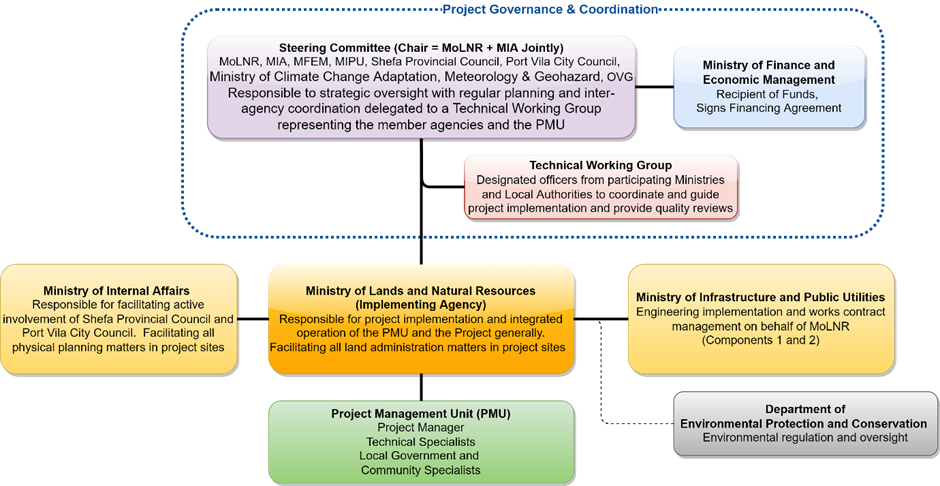
The Ministry of Finance and Economic Management is the Executing Agency, and the Ministry of Lands and Natural Resources (MoLNR) is the Implementing Agency, supported by a dedicated Project Management Unit and partner agencies.
The original US$25 million International Development Association grant was supplemented by US$28 million in Additional Financing approved in March 2026. This comprises US$12 million to replenish resources redirected through the Rapid Response Option following the December 2024 earthquake, and US$16 million for expanded activities. US$41 million is allocated to project components.
Develops Elol Etas Subdivision, providing approximately 130 serviced residential lots to improve access to affordable land. The construction of approximately four (4) Low Cost Model Homes will demonstrate affordable, resilient construction, while the Etas Market and Bus Exchange will support livelihoods, public transport and community access to services.
Upgrades infrastructure in Tokyo, Seaside, Ohlen Mataso and Anamburu. Works include road improvements, pathways and accessible ramps, drainage and flood mitigation, community and street lighting, and waste-management through elevated community trash racks. These investments aim to improve safety, accessibility, living conditions and disaster resilience.
Strengthens institutional capacity through organisational reform, corporate planning, staff development, improved land administration and digital land and revenue-management systems. It also supports a new resilient, accessible and energy-efficient MoLNR headquarters to improve public service delivery and safeguard national land records.
Allows project funds to be reallocated to support urgent response and recovery following an eligible crisis or emergency. It has no initial funding allocation and can be activated at the Government’s request, subject to World Bank approval and applicable operational and safeguards requirements.
Institutional and implementation arrangements are shown in Figure 1.
All environmental and social safeguards documents are disclosed to the public.
The Environmental and Social Commitment Plan (ESCP) sets out the measures and actions the Government of Vanuatu has committed to undertake so that VARS meets the World Bank’s Environmental and Social Standards.
The ESCP specifies responsibilities and timeframes for safeguards instruments, staffing, stakeholder engagement, monitoring and reporting, and forms part of the project’s legal obligations under the Financing Agreement.
The Environmental and Social Management Framework (ESMF) establishes how VARS identifies, assesses and manages environmental and social risks across project activities.
It guides screening, preparation of site-specific safeguards instruments, mitigation, monitoring and implementation responsibilities, consistent with Vanuatu’s requirements and the World Bank’s Environmental and Social Standards.
Component 1 supports affordable and resilient new settlement development through the Elol Etas Subdivision, providing approximately 130 serviced residential lots with roads, drainage, water, electricity and open spaces. It also supports construction of approximately four (4) Low Cost Model Homes to demonstrate affordable, resilient construction, and the Etas Market and Bus Exchange will support livelihoods and access to public transport. The component strengthens planning and systems to guide future settlement development. The following safeguards instruments have been prepared to ensure compliance with the ESMF.
Documents land ownership, customary landholder consent, negotiated benefits and land-related impacts associated with the subdivision.
Sets out how stakeholders are informed and consulted, including arrangements for raising and resolving grievances.
Assess the subdivision’s environmental and social risks and specify mitigation measures, responsibilities and monitoring.
Prepared to meet the DEPC environmental approval process and establish environmental protection and monitoring requirements.
Component 2 provides upgrades to infrastructure in Tokyo, Seaside, Ohlen Mataso and Anamburu through road improvements, drainage, pathways and accessible ramps, community and street lighting, and waste-management measures. These works aim to improve living conditions, safety, accessibility and resilience to flooding. The supporting safeguards instruments are:
Set out measures to manage environmental and social risks during construction and operation, with responsibilities and monitoring requirements.
Guide stakeholder information, consultation, community liaison and grievance handling.
Addresses the relocation of the household affected by works within the road reserve, including assistance and follow-up monitoring.
Documents the negotiated acquisition of portions of two leasehold titles for the expanded infiltration basin, including consultation, valuation, agreements and payment requirements before works commence on the acquired land.
To be published once cleared by the World Bank.
Component 3 strengthens institutional capacity through organisational reform, corporate planning, staff development, and modernisation of land administration and revenue-management systems. It also supports a new resilient, accessible and energy-efficient MoLNR headquarters to improve public service delivery and protect national land records. The supporting safeguards instruments include:
Sets out environmental and social mitigation and monitoring measures for demolition, including worker and community safety and waste management. The demolition is an associated facility of VARS but is carried out separately, outside the project.
Guides consultation and information sharing with departments, staff, partner agencies and other stakeholders to inform the new headquarters’ design, including accessibility and public-service needs.
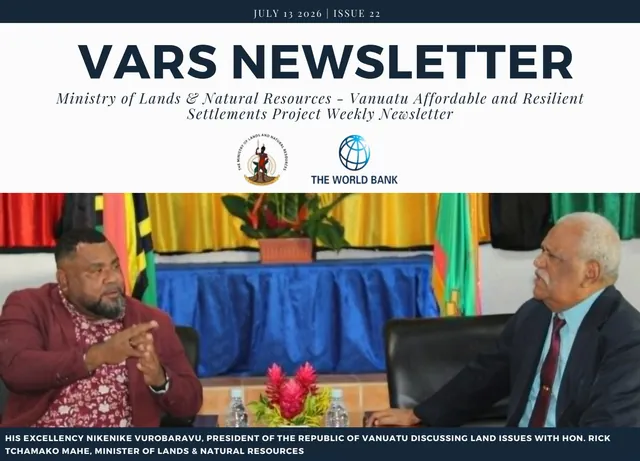
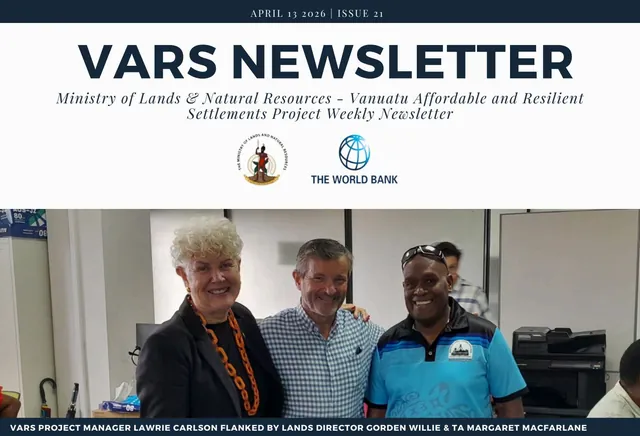
22 issues to date. The two latest are below; every issue is under “All Issues”.
The Help Desk at the Project Management Unit (PMU) is established to receive your calls or email and will help project stakeholders to receive information or register a request for design change or to resolve any concerns that may arise as a result of the project. The PMU records each matter, coordinates responses with relevant agencies or contractors, and tracks follow-up actions and resolution through the Help Desk Register.
Complaint forms are also available from the works contractors. Contact the Community Liaison Officer for your site:
Use this form to ask a question, request a change to the project design, or raise a complaint or grievance.
Fields marked * must be filled in. Everything you send is treated confidentially by the Project Management Unit.
 Ministry Cabinet
 Department of Lands, Survey & Records
 Department of Water Resources
 Corporate Services Unit
 Department of Water Resources
 Geology & Mines Unit
 Office of the Valuer General